- 1. The Philosophy of Hygge and Lagom
- 2. Historical Roots: From Functionalism to Modernism
- 3. The Foundation: Whitewashed and Soaped Flooring
- 4. The Color Palette: Beyond the Stark White Myth
- 5. Lighting Architecture: Conquering the Long Dark
- 6. Furniture Silhouettes: The Legacy of Mid-Century Masters
- 7. Textile Layering: The Art of Softening Edges
- 8. Japandi Fusion: Where Nordic Meets Zen
- 9. Biophilic Elements: Bringing the Forest Indoors
- 10. The Focal Point: Rethinking the Fireplace and TV
- 11. Window Treatments: Maximizing Every Lumen
- 12. Curating Decor: The Rule of Meaningful Objects
- 13. Smart Storage: The Secret to Minimalist Calm
- 14. Sourcing Heirlooms: Vintage vs. Contemporary Investments
- Frequently Asked Questions
Yesterday, while rummaging through a dusty thrift store on the edge of town, my fingers brushed against a small, battered teak bowl. It wasn’t perfect. There was a faint scratch along the rim and the finish had worn down to a matte, honeyed warmth where countless hands must have held it before mine.
I bought it immediately.
That bowl represents everything I love about Scandinavian design. It wasn’t just an object; it was a memory keeper. It felt like something my grandmother would have kept on her side table, filled with peppermints or sewing notions. In a world that constantly pushes us to buy the newest, shiniest plastic thing, I find myself retreating more and more to the Nordic philosophy of the home.
It’s not just about an aesthetic. It’s about creating a space that holds you.
Many people mistake Scandinavian design for cold minimalism. They see white walls and think “sterile.” But true Nordic living room design is actually deeply rooted in warmth, survival, and the profound need for a sanctuary against the harsh elements outside.
I want to walk you through how to build this atmosphere in your own home. Not as a checklist of trends, but as a collection of timeless principles that honor the past while comforting your present self.
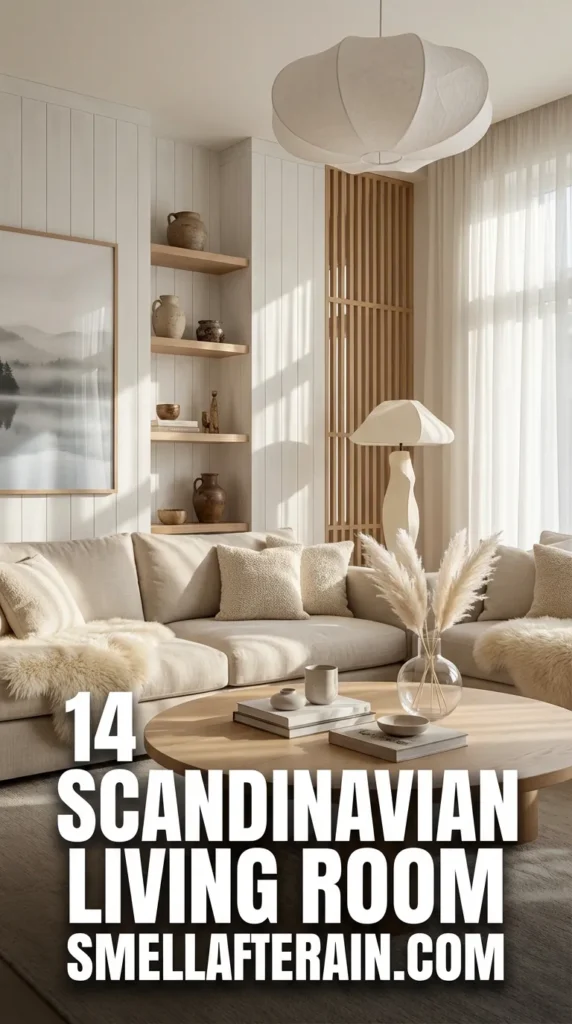
1. The Philosophy of Hygge and Lagom
Before we move a single piece of furniture, we have to talk about the soul of the room.
You’ve likely heard of Hygge (pronounced hoo-ga). It’s that feeling of cozy contentment—cocoa by the fire, wool socks, the sound of rain against the glass. It is the antidote to the cold.
But there is another concept I love even more: Lagom.
Lagom translates roughly to “not too little, not too much. Just right.” It is the enemy of excess. In a living room, this means finding a balance where the room feels full of life but never cluttered. It is a guide to minimalist living room layouts that prioritizes breathing room over empty space.
When you look at your room, ask yourself: Does this space serve me, or am I serving the stuff in it?
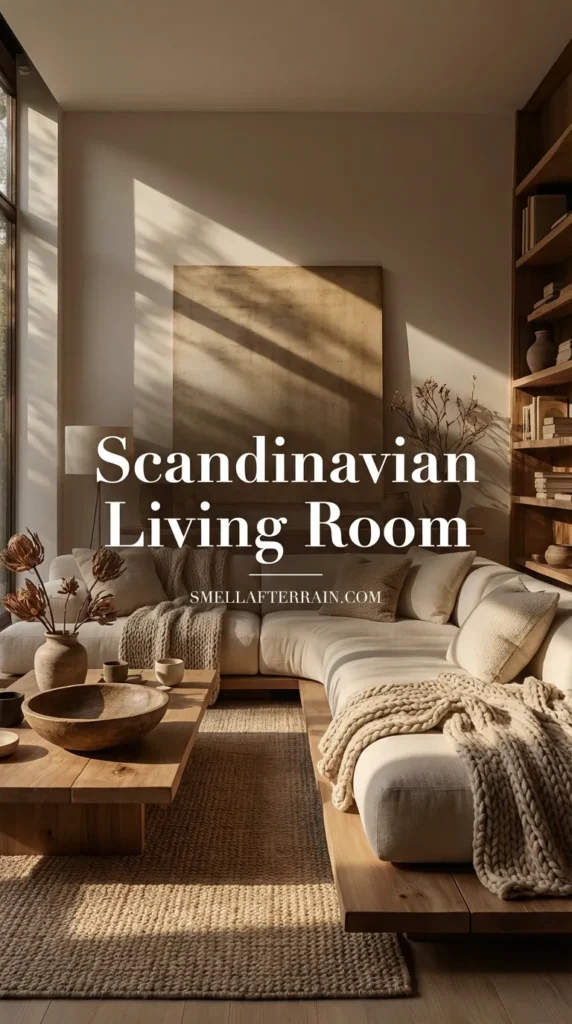
2. Historical Roots: From Functionalism to Modernism
To truly understand this style, we have to look back. I often think about the mid-20th century, a time when resources were scarce and design had to be clever.
The Golden Age of Scandinavian design (the 1930s to the 1970s) was driven by democratic ideals. Designers like Alvar Aalto and Arne Jacobsen believed that beautiful, functional objects shouldn’t just be for the wealthy. They should be accessible to everyone.
This history is why Scandi furniture is so robust. It was built to be used, not just looked at. It’s why I always encourage you to look for vintage pieces with a history.
When you bring a vintage Kaare Klint chair or a gentle teak sideboard into your home, you are bringing in a piece of history that values craftsmanship over mass production. It creates a sense of permanence that brand-new flat-pack furniture just can’t replicate.
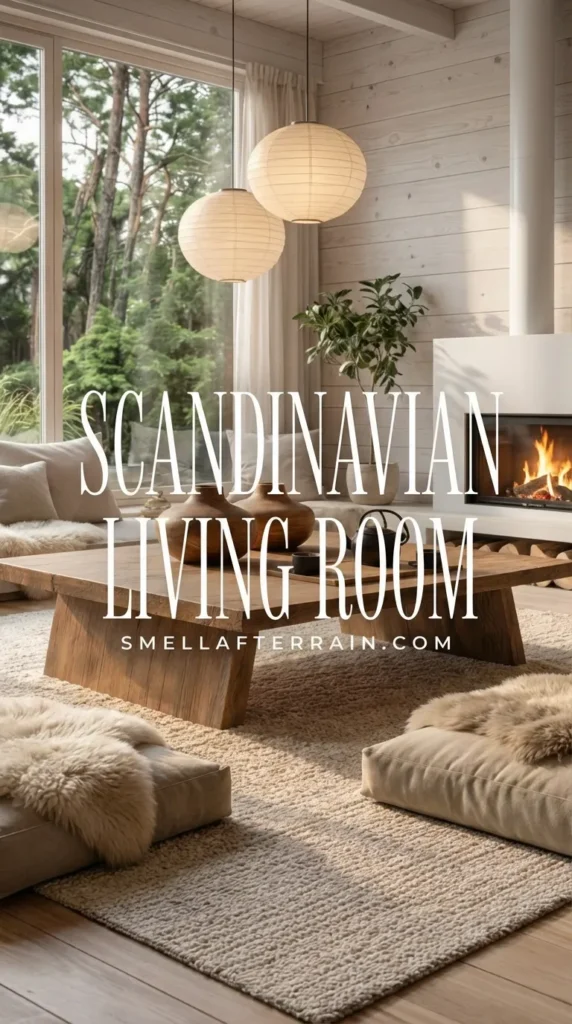
3. The Foundation: Whitewashed and Soaped Flooring
If you walk into a traditional home in Copenhagen or Stockholm, one thing you will rarely see is wall-to-wall carpeting.
Historically, carpets were hard to clean and trapped dust. Instead, the Nordic standard is wood. But not just any wood.
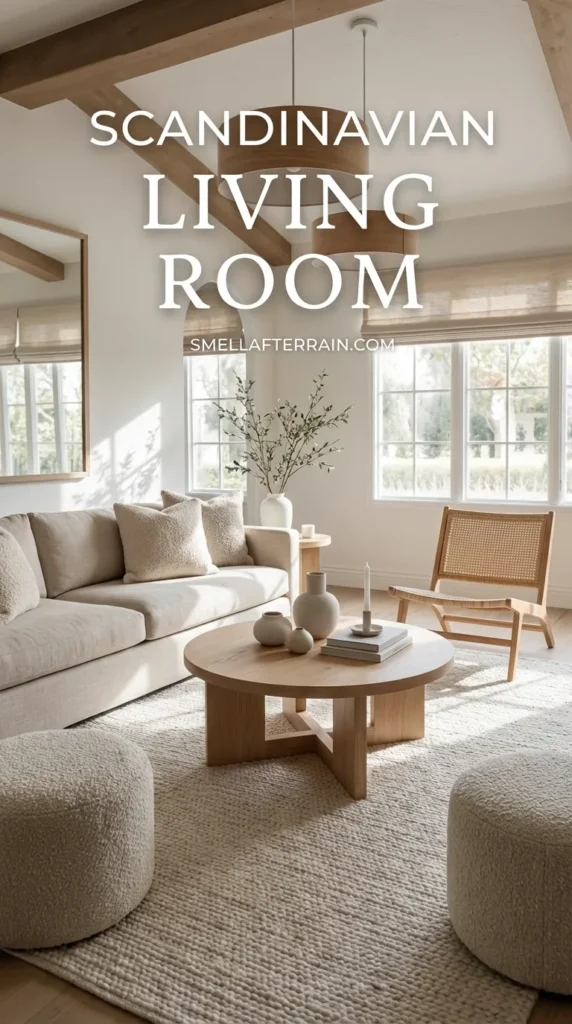
We are talking about light woods—pine, ash, or oak—often treated with lye or soap flakes to stop them from yellowing. This technique preserves the pale, natural look of the timber.
Why so light? It comes back to the light itself. In a region where winter days are short and dark, the floor acts as a reflector. A dark floor absorbs the precious little daylight available; a white-washed floor bounces it back up into the room.
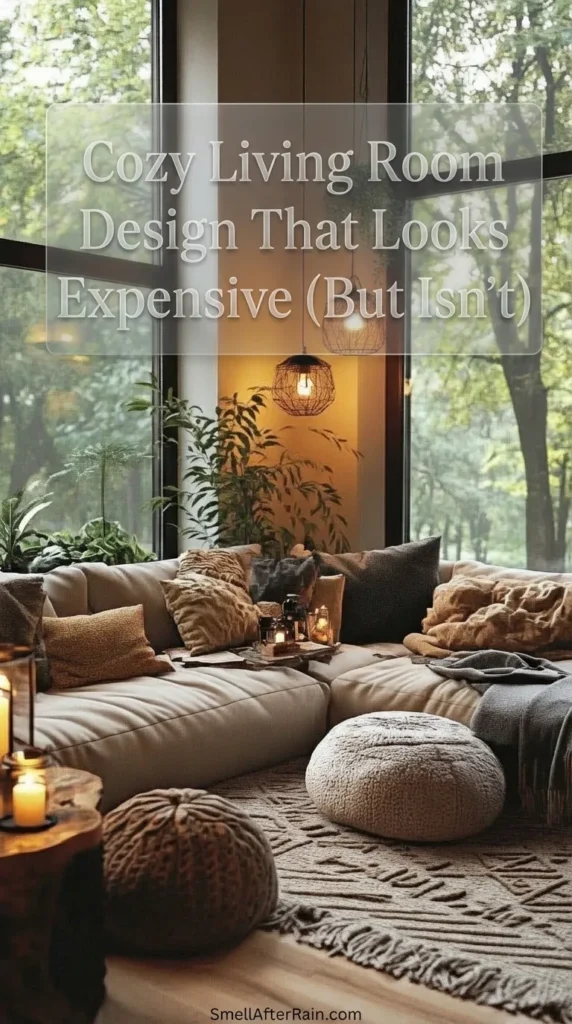
If you are stuck with dark floors or carpet you can’t remove, don’t panic. This is where large, light-colored area rugs come in. I discuss this technique in my article on designing cozy living rooms that look expensive, where layering rugs can completely transform the light quality of a space.
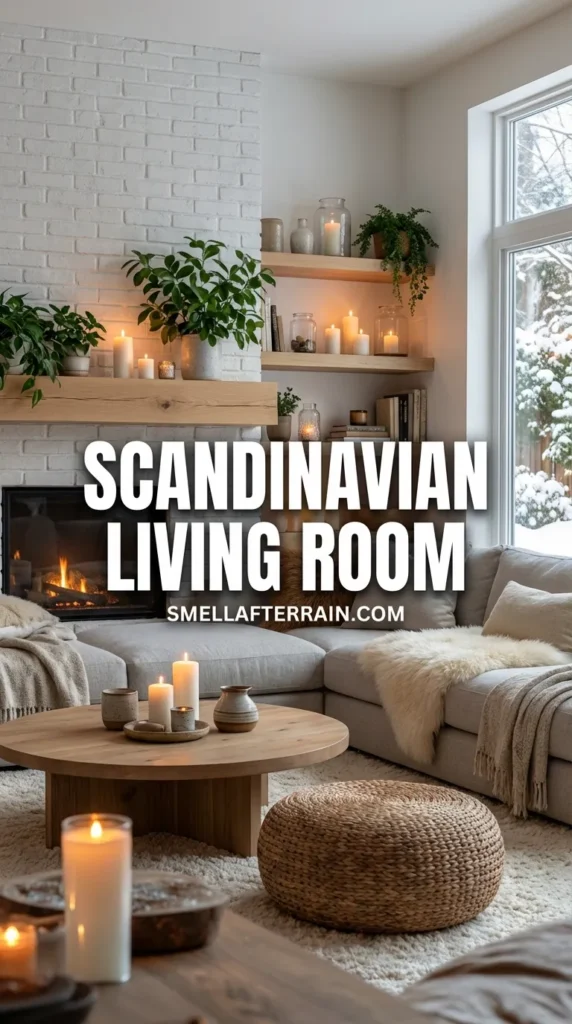
4. The Color Palette: Beyond the Stark White Myth
Here is a secret: Scandinavian homes are rarely pure, hospital white.
While white is a staple, the true palette is drawn from the Nordic landscape. Think of the colors you see on a walk through a misty forest or along a rocky coastline.
- Soft Greige: The color of unbleached linen.
- Muted Sage: The color of dried lichen on granite.
- Dusty Blue: The color of the sea on a cloudy day.
- Charcoal: To provide grounding contrast.
These colors are soothing. They don’t scream for attention. They wrap the room in a gentle hug. I recently experimented with a “greige” wash on my own walls, and the way it changes with the setting sun is magical—far warmer than stark white.
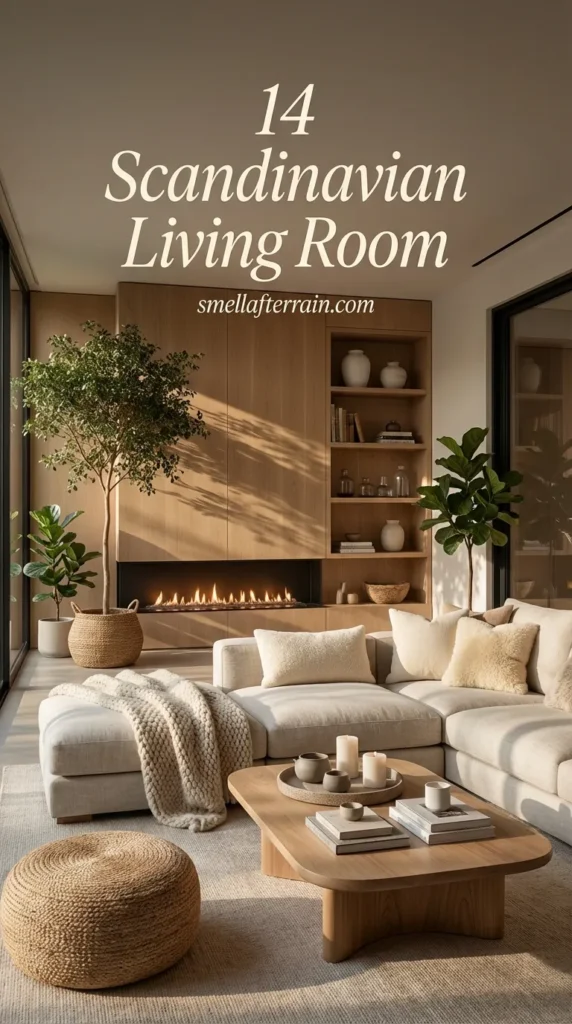
5. Lighting Architecture: Conquering the Long Dark
Lighting is not an afterthought in Scandinavia; it is a survival mechanism.
Because the winters are so long and dark, the way we light our homes affects our mental health. The rule here is simple: never rely on a single overhead light source.
We need to create “islands of light.”
I suggest a mix of three layers:
- Ambient: A soft pendant (like the iconic PH5 lamp) that diffuses light without glare.
- Task: A focused floor lamp by the reading chair.
- Mood: Candles. Lots of them.
The flicker of a real flame is essential to Hygge. It taps into something primal. Even if you don’t light them every night, having candlesticks ready suggests that warmth is always available.
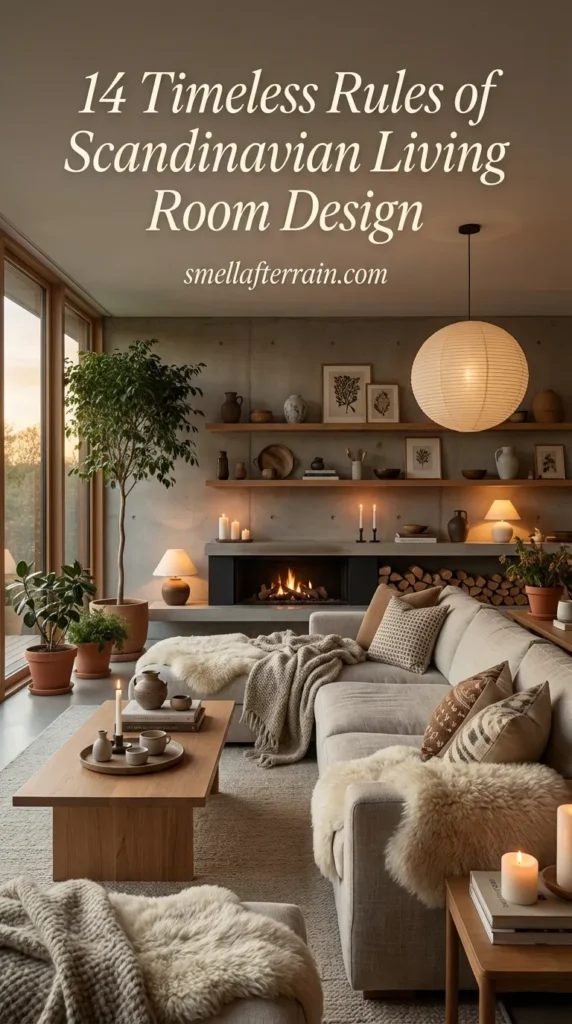
6. Furniture Silhouettes: The Legacy of Mid-Century Masters
When selecting furniture, I look for pieces that feel “light” on their feet.
Notice how many Scandi sofas and sideboards sit on raised wooden legs? This isn’t just an aesthetic choice. By lifting the bulk of the furniture off the floor, you allow light and air to flow underneath.
It tricks the eye into thinking the room is larger than it is.
The lines should be clean and organic—no sharp, aggressive angles. Think of the curve of a pebble or the bend of a branch. If you are looking for specific furniture examples, I have a collection of favorites in my guide to contemporary living room styling.
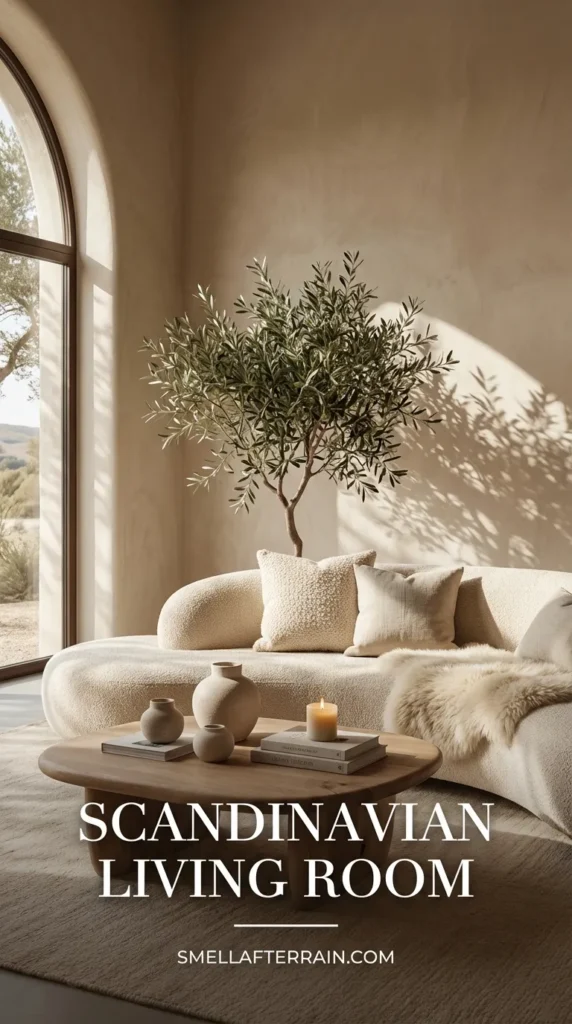
7. Textile Layering: The Art of Softening Edges
Texture is my love language. In a room with simple furniture and neutral colors, texture is what prevents boredom.
Since we aren’t using loud patterns, we use tactile contrast. I love mixing materials that feel different against the skin:
- Rough wool throws against smooth leather.
- Cool linen pillows against a velvet sofa.
- A sheepskin drape over a hard wooden chair.
This layering invites touch. It tells your guests, “It’s okay to sit here. It’s okay to relax.” I’ve always felt that a home you’re afraid to touch isn’t really a home at all.
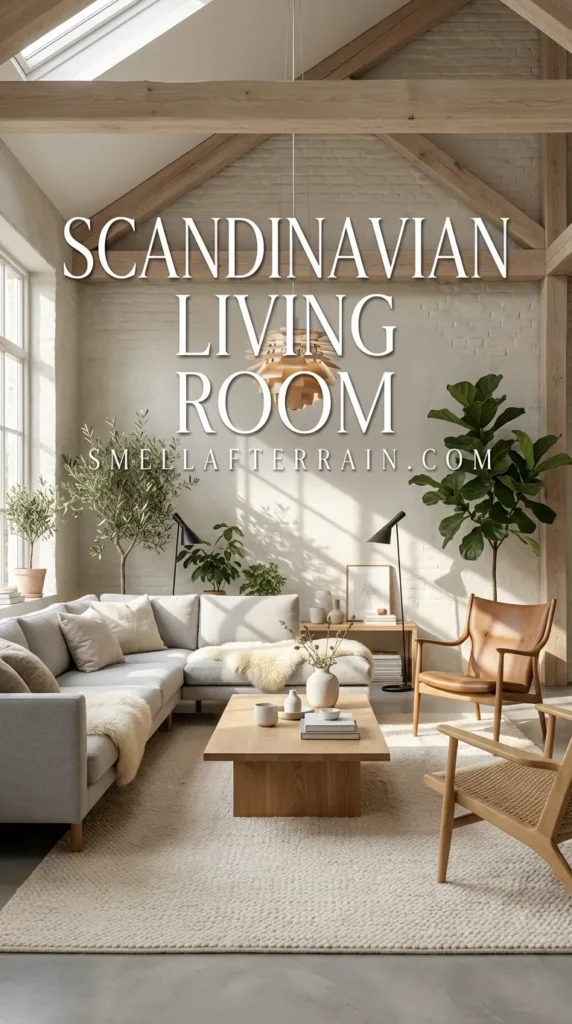
8. Japandi Fusion: Where Nordic Meets Zen
Lately, there has been a beautiful convergence of styles known as Japandi.
It makes perfect sense. Both Japan and Scandinavia share a deep respect for craftsmanship, natural materials, and simplicity. While Scandi tends to be a bit more rustic and cozy (Hygge), Japanese design brings a refined, sleek elegance (Wabi-Sabi).
Integrating Japandi means embracing imperfection. It means choosing a ceramic vase that is slightly asymmetrical or a wooden table with a visible knot.
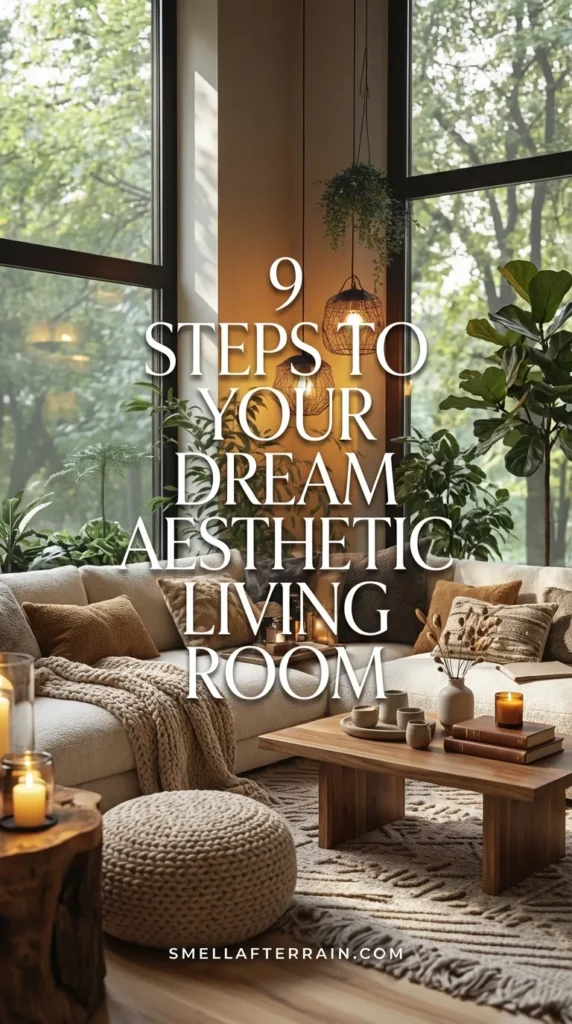
If this blend intrigues you, I’ve written extensively about achieving this balance in my comprehensive 9-step aesthetic guide. It’s about finding the quiet space between the two cultures.
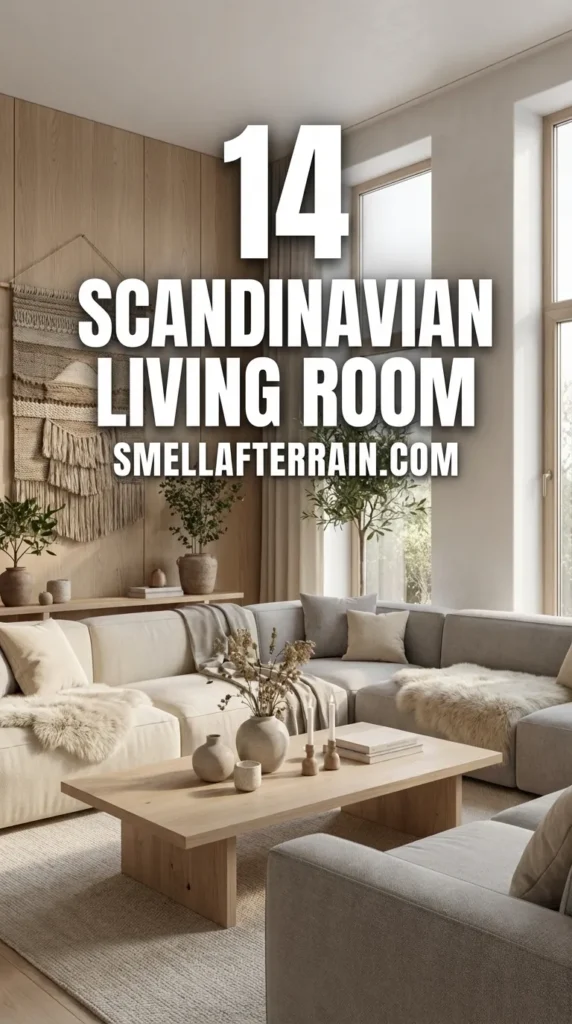
9. Biophilic Elements: Bringing the Forest Indoors
Scandinavians have a profound connection to nature. When the weather is too harsh to go outside, you bring the outside in.
This goes beyond just having a potted plant in the corner (though that helps). It’s about structural elements.
I love using raw wood stumps as side tables. I love displaying a collection of river stones in a glass bowl. I love dried branches in a tall vase that cast intricate shadows on the wall.
These elements ground us. They remind us of the slow pace of the natural world, which is a welcome contrast to our fast-paced digital lives.
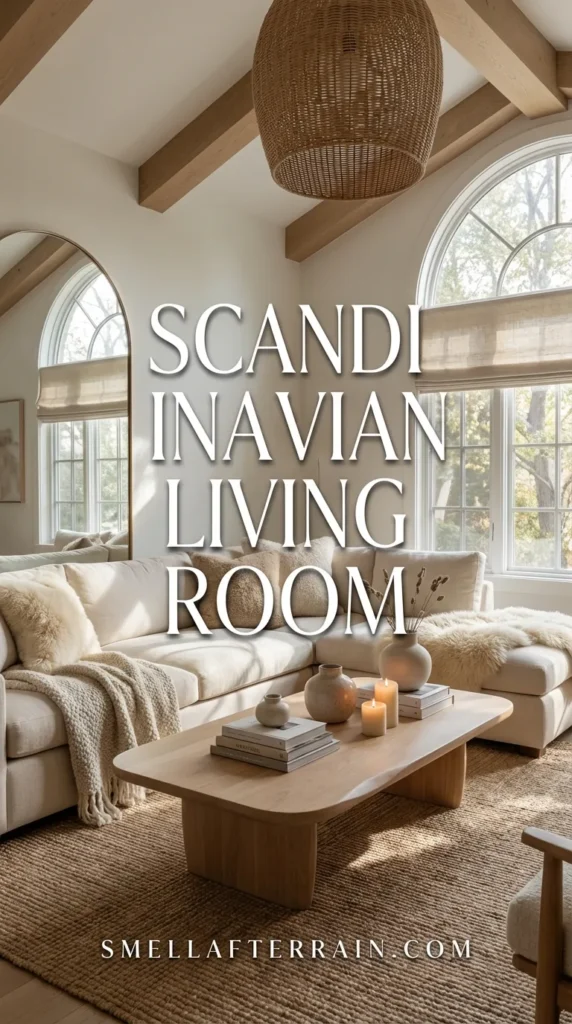
10. The Focal Point: Rethinking the Fireplace and TV
In many modern homes, the massive black rectangle of the TV is the undisputed king of the living room. In traditional Scandi design, the hierarchy is different.
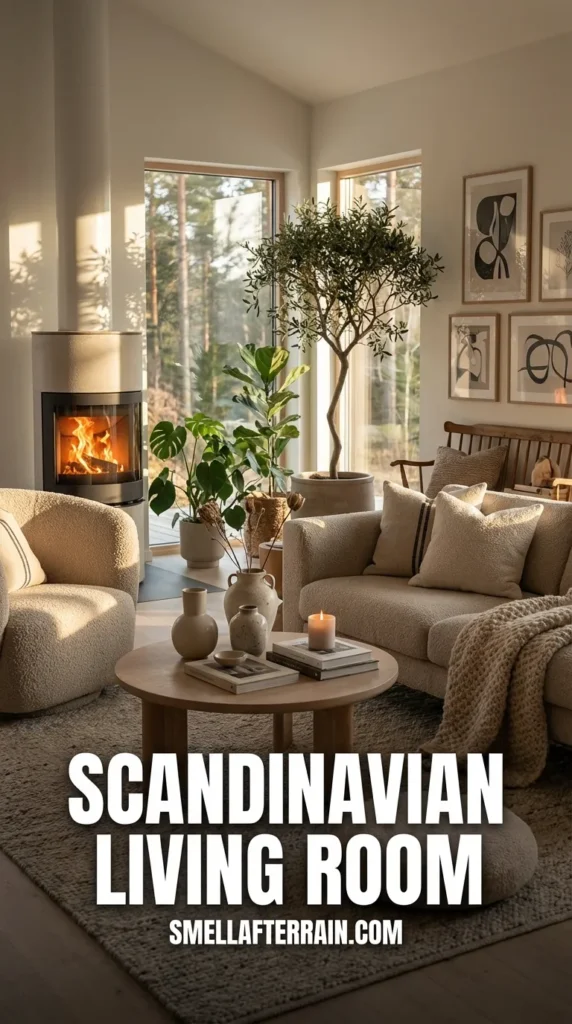
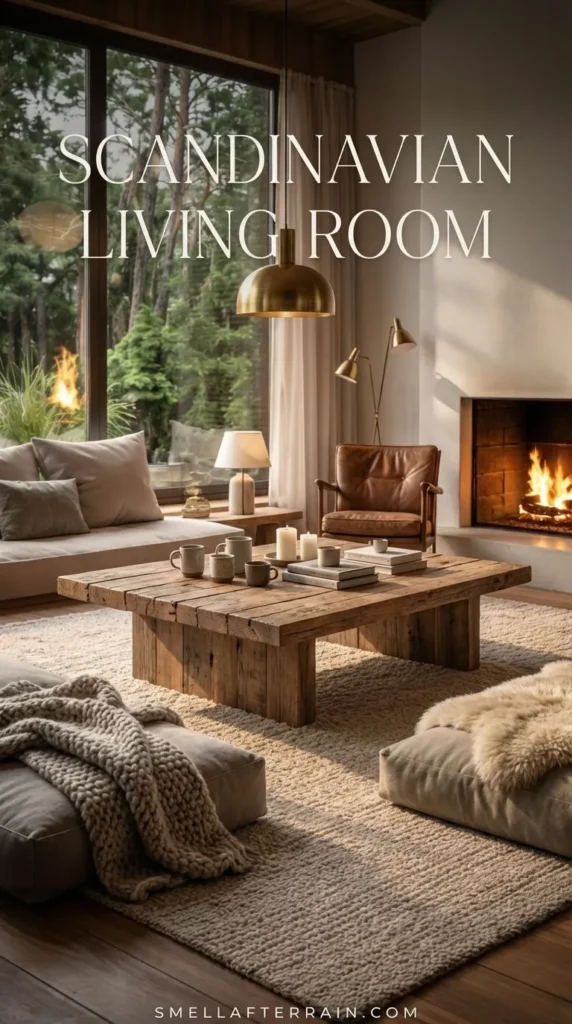
The fireplace—historically the ceramic Kakelugn—was the center of the home. It provided the heat necessary for survival.
Even if you don’t have a working fireplace, try to orient your furniture to encourage conversation rather than just screen viewing. Create a “social circle” with your seating.
If the TV is necessary (and let’s be honest, it usually is), try to treat it as a secondary element. Frame it with dark shelving or place it off-center so it doesn’t dominate the room’s energy.
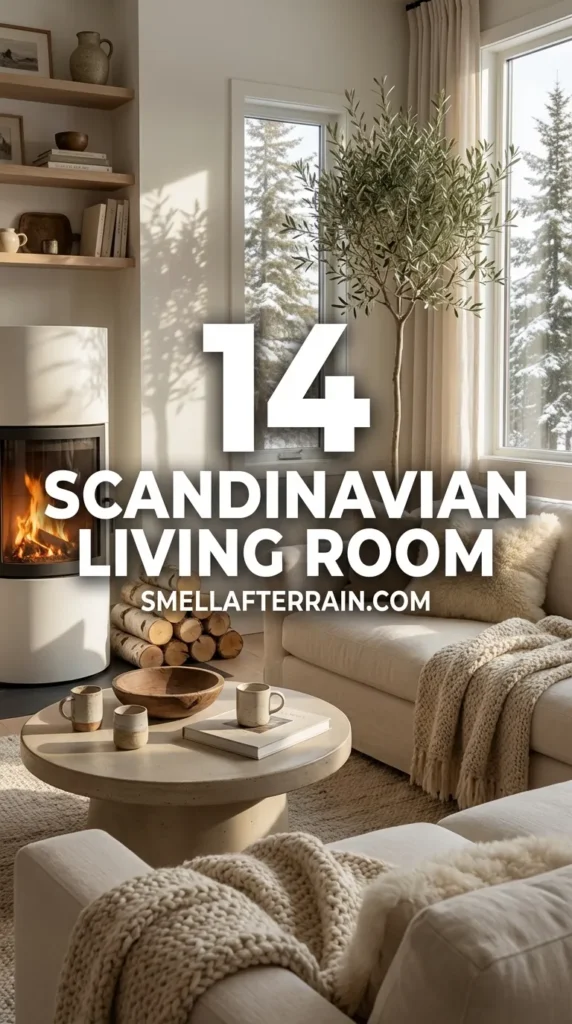
11. Window Treatments: Maximizing Every Lumen
I have a controversial opinion: I hate heavy curtains.
In a Scandinavian living room, you want to strip back anything that blocks the window pane. We want to maximize that natural light intake.
Ideally, windows are left bare. But if privacy is an issue, opt for sheer, gauzy linen curtains that filter light rather than blocking it. They should billow slightly in the breeze, adding another layer of soft movement to the room.
Avoid heavy velvets or dark brocades at the window. They feel too heavy and stagnant for this style.
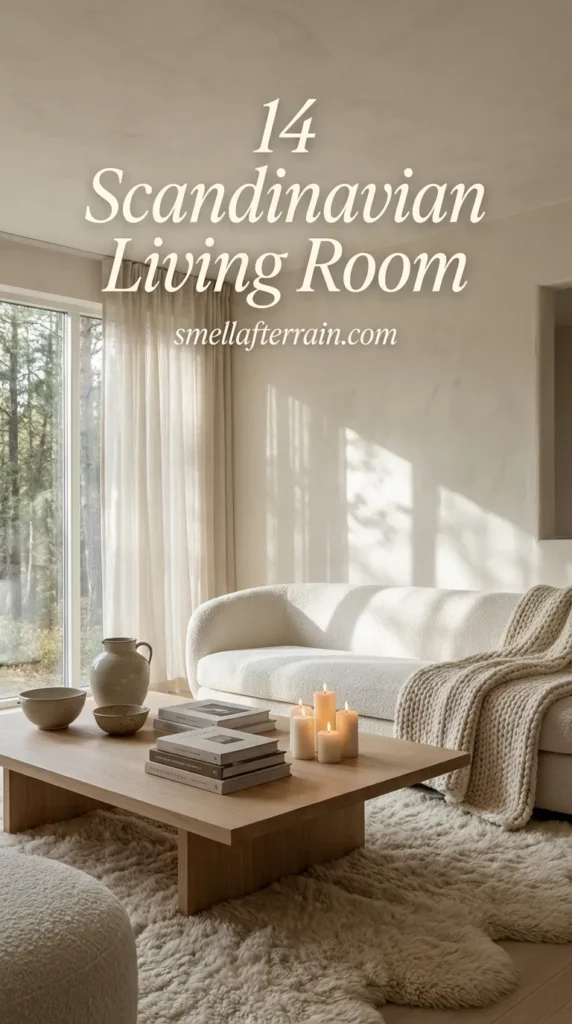
12. Curating Decor: The Rule of Meaningful Objects
This brings me back to my thrifted teak bowl.
Decor in a Scandi room should never be “filler.” Every item on your shelf should have a reason to be there. It should either be useful (functional) or beautiful (emotional).
I prefer to display collections of similar items—a cluster of ceramic vases, a stack of art books, or a row of glass candle holders.
When you group items, they become a visual unit, which looks less cluttered than scattering them around the room. It’s a curation technique I often discuss when exploring luxury living room styling principles.
13. Smart Storage: The Secret to Minimalist Calm
You cannot have a calm mind in a chaotic room.
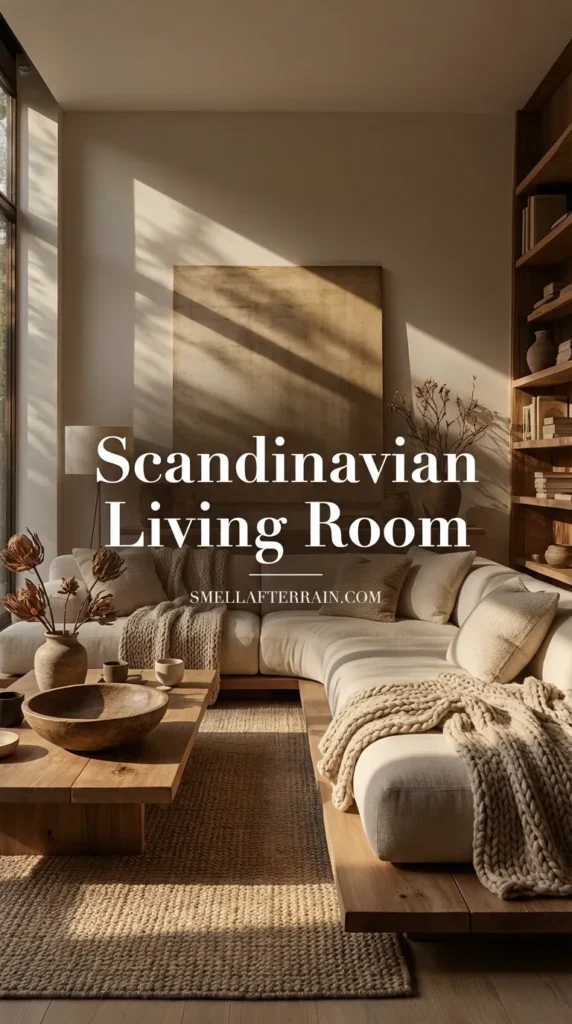
The clean lines of Scandinavian design are only possible if the clutter is hidden away. This is where clever cabinetry comes in. Floor-to-ceiling storage units that blend into the walls are a staple.
I love sideboards with sliding doors. They allow you to sweep away the daily mess—mail, chargers, toys—in seconds. The goal is to have surfaces that remain relatively clear, allowing the eye to rest.
It’s not about owning nothing; it’s about organizing what you own with intention.
14. Sourcing Heirlooms: Vintage vs. Contemporary Investments
Finally, let’s talk about buying.
We live in a “fast furniture” culture. We buy cheap, use it for three years, and throw it away. This is the antithesis of the Scandinavian ethos.
I encourage you to save up for one beautiful, high-quality piece rather than buying five cheap ones. A solid oak coffee table will age with you. It will get scratches and dents, and it will only look better for them.
Visit flea markets. Look for estate sales. Find pieces that have already lived a life. Mixing these vintage treasures with modern basics creates a home that feels established and timeless.
If you are looking for inspiration on how to blend these styles, browse through my favorite finds on the Smell After Rain homepage to see how I curate my own collection.
Frequently Asked Questions
Can I do Scandinavian style if I have kids and pets?
Absolutely. In fact, Scandi design is incredibly practical for families. The emphasis on durable materials like wood, leather, and wool means furniture can withstand wear and tear better than delicate synthetics. Washable slipcovers on sofas are a common Scandi hack for keeping things fresh without stressing over spills.
Is Scandinavian design expensive?
It doesn’t have to be. While designer pieces like the Wishbone Chair are pricey investments, the philosophy is about simplicity. You can achieve the look by decluttering, painting walls a fresh white or greige, and adding thrifted wooden furniture and natural textiles. It’s more about the mindset than the price tag.
How do I make a Scandi room feel cozy and not cold?
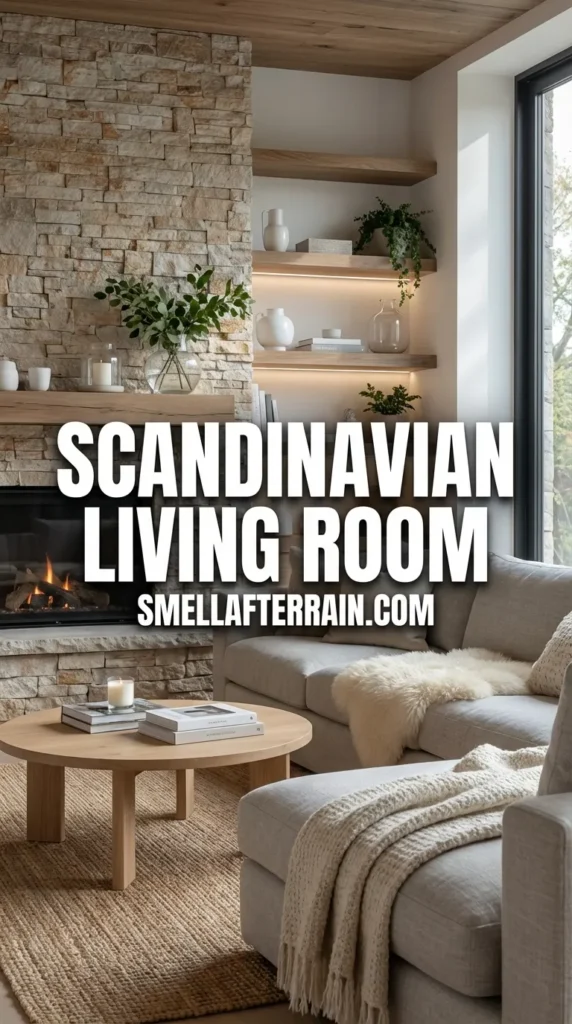
The secret is texture and lighting. If your room feels like a clinic, you likely have too many smooth, hard surfaces and cool-toned lights. Add a high-pile wool rug, drape a chunky knit blanket over the sofa, and switch your lightbulbs to a warm white (2700K). These small shifts add instant warmth.
What is the difference between Hygge and Minimalism?
Minimalism is often about the reduction of objects to the bare essentials, sometimes resulting in a stark aesthetic. Hygge is about the feeling of the space. You can have a minimalist room that lacks Hygge (cold, empty) and a Hygge room that isn’t strictly minimalist (filled with books and candles). The best Scandi interiors balance both.
Can I use dark colors in a Scandinavian living room?
Yes! While light colors are traditional to maximize daylight, modern Nordic design often embraces “Scandi Noir.” This involves using deep charcoals, forest greens, or navy blues on walls to create a moody, cocoon-like atmosphere, usually balanced with light wood furniture and warm lighting.
Creating a home is a slow process. It’s about waiting for the right piece, like that teak bowl I found, rather than rushing to fill a corner. Take your time. Let your home grow with you.