
- 1. The Floating Vanity Principle: Recovering Floor Space
- 2. Continuous Tiling: The Infinity Effect
- 3. The Wet Room Revolution: Eliminating Barriers
- 4. Vertical Storage Towers: Utilization of the Y-Axis
- 5. Frameless Glass Partitions: Invisible Boundaries
- 6. Wall-Mounted Cabinetry and Fixtures: Reduced Visual Weight
- 7. Strategic Mirror Placement: Doubling Depth
- 8. Recessed Niche Engineering: Flush Storage Solutions
- 9. The Monochromatic Palette: Reducing Visual Noise
- 10. Lighting Layering: Expanding Corners
- 11. Pocket Door Installation: Reclaiming Swing Arcs
- 12. Curated Corner Fixtures: Utilizing Dead Zones
- Frequently Asked Questions
- Conclusion

Designing a functional and aesthetically pleasing space within a limited footprint is one of the greatest challenges in interior architecture. When dealing with a super small bathroom, the margin for error is nonexistent. Every inch of floor space, wall real estate, and lighting trajectory must be calculated to maximize flow and utility. However, a constrained footprint does not mean you must sacrifice luxury or style. In fact, constraints often breed the most creative solutions.
As we explore these architectural strategies, we move beyond simple decoration. We are looking at structural and layout methodologies—what spatial architects call “visual expansion tricks”—to trick the eye and physically open up the room. Whether you are renovating a small full bathroom or trying to squeeze functionality into a tiny powder room, the goal remains the same: reduce visual clutter and maximize the perception of volume.
By applying principles of light refraction, verticality, and continuous lines, you can transform a cramped quarter into a calm, aesthetic bathroom sanctuary. At Smell After Rain, we believe that even the smallest spaces deserve grand design thinking. Below are 12 architect-approved hacks to revolutionize your tiny bathroom design.
1. The Floating Vanity Principle: Recovering Floor Space
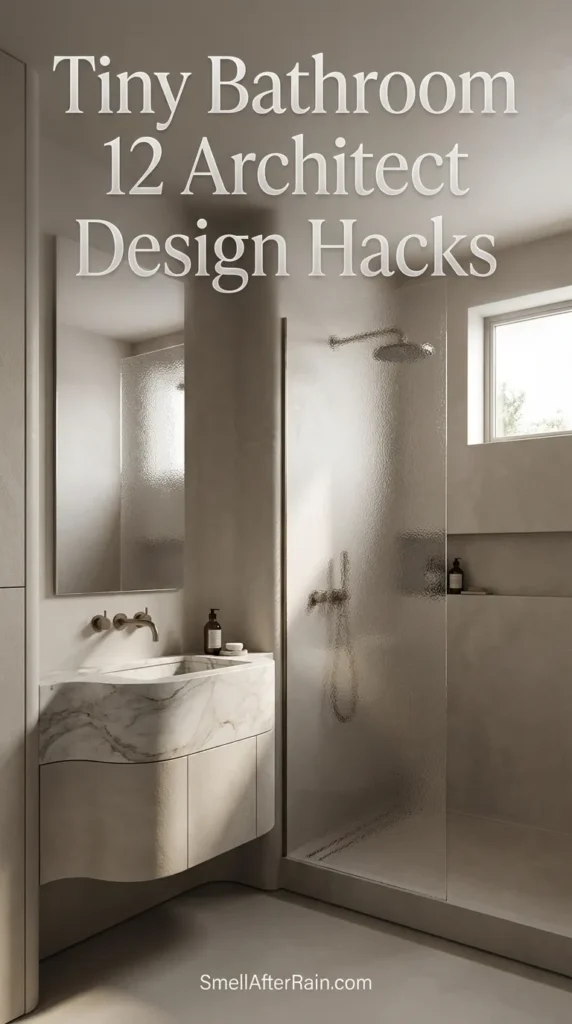
In a standard bathroom layout, bulky cabinetry anchored to the floor creates a heavy visual block. It interrupts the line of sight across the floor, immediately registering the room as “small” to the human brain. The antidote to this is the floating vanity.
Architectural Analysis
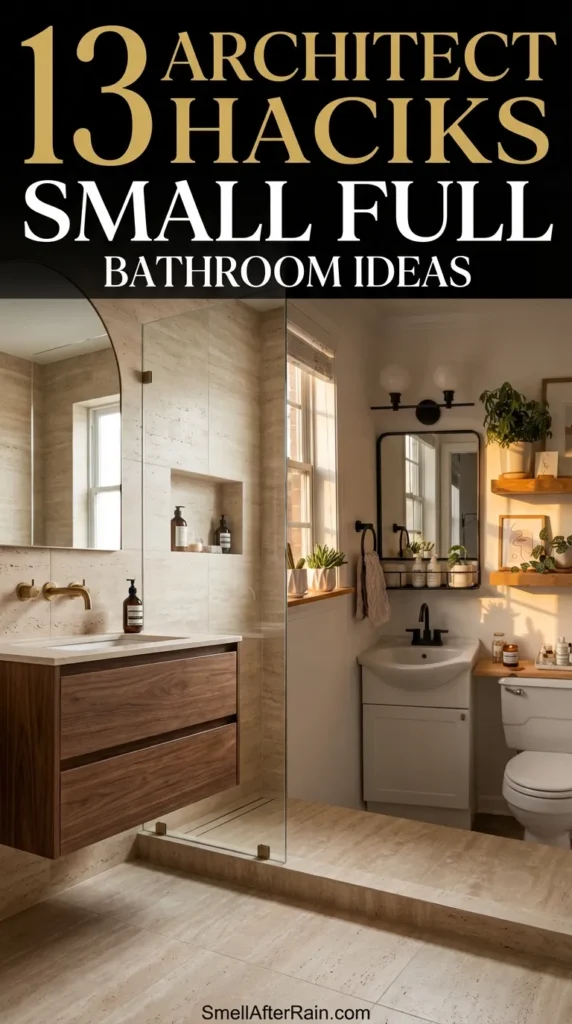
By mounting the vanity to the wall and leaving the floor space beneath it open, you extend the visible floor area. The eye can travel all the way to the wall, creating an illusion of a larger footprint. This is a staple in spatial architect hacks for tight quarters. Additionally, this gap allows for the placement of baskets or scales without cluttering the main walkway, maintaining a clean aesthetic.
Material choice matters here. Opting for a vanity with clean lines and a finish that complements the walls further integrates the piece into the architecture, rather than letting it stand out as an intrusion.
2. Continuous Tiling: The Infinity Effect
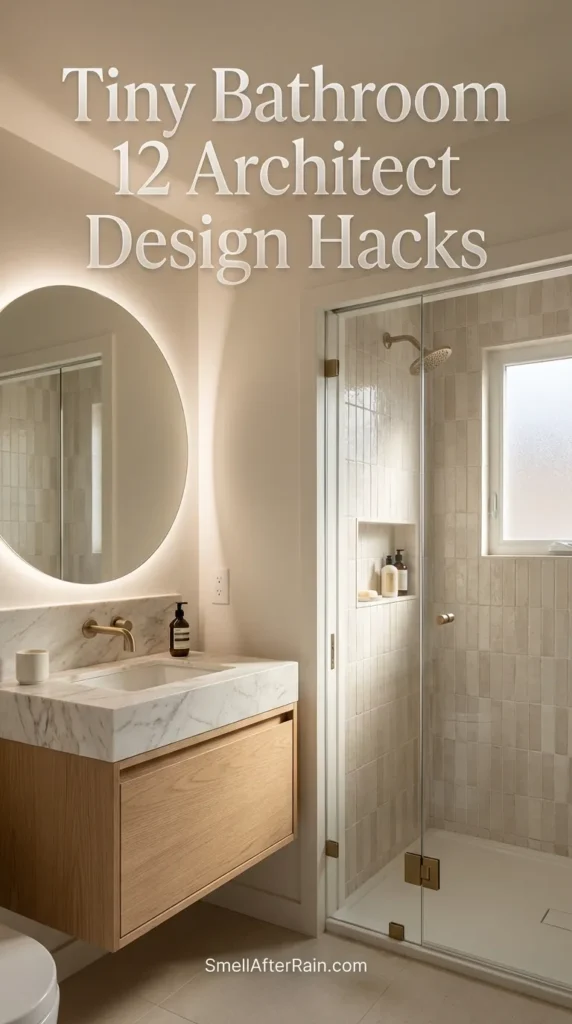
Visual breaks shrink spaces. When the floor material stops and the wall material begins, the brain defines the boundaries of the room rigidly. To combat this, architects employ continuous tiling—using the same tile for both the floors and the walls, specifically in the shower area or wet zones.
Material Science
Large-format tiles are preferred over small mosaics in this application. Fewer grout lines mean less visual “noise.” When the tile runs from the floor up the wall to the ceiling, it draws the eye upward, emphasizing height rather than the lack of width. This technique is often seen in high-end spas and is a core component of modern bathroom luxury rules.
If using stone or porcelain with veining, try to align the direction of the veins to lead the eye toward a focal point, such as a window or a beautiful fixture, further enhancing the sense of flow.
3. The Wet Room Revolution: Eliminating Barriers
Traditional shower curbs (the small step you take to enter a shower) act as physical and visual dividers. In a tiny shower room, these dividers chop up the space, making a 5×7 room feel like two 2.5×7 cages. A wet room layout removes the curb entirely and waterproofs the entire floor.
Spatial Flow
By grading the floor slightly toward a linear drain, you eliminate the need for an enclosure threshold. This allows the flooring to run uninterrupted from the door to the back wall. It transforms a cramped bathroom into an open, European-style wet room. This is particularly effective for small ensuite shower rooms where every inch counts. It also improves accessibility, a key consideration for long-term home value.

4. Vertical Storage Towers: Utilization of the Y-Axis
When the X and Z axes (floor space) are restricted, you must build along the Y-axis (height). Many homeowners ignore the space above the toilet or near the ceiling, leaving it empty while countertops become cluttered. Vertical storage towers or tall, narrow cabinetry can house linens and toiletries without expanding the room’s footprint.
Design Integration
To keep the look minimalist, recessed tall cabinets are ideal. If structural modifications aren’t possible, choose tall, slender shelving units that match the wall color. The goal is to make the storage disappear into the architecture. Open shelving high up can also serve as a display for plants, adding a biophilic element that breathes life into a super small bathroom.
5. Frameless Glass Partitions: Invisible Boundaries
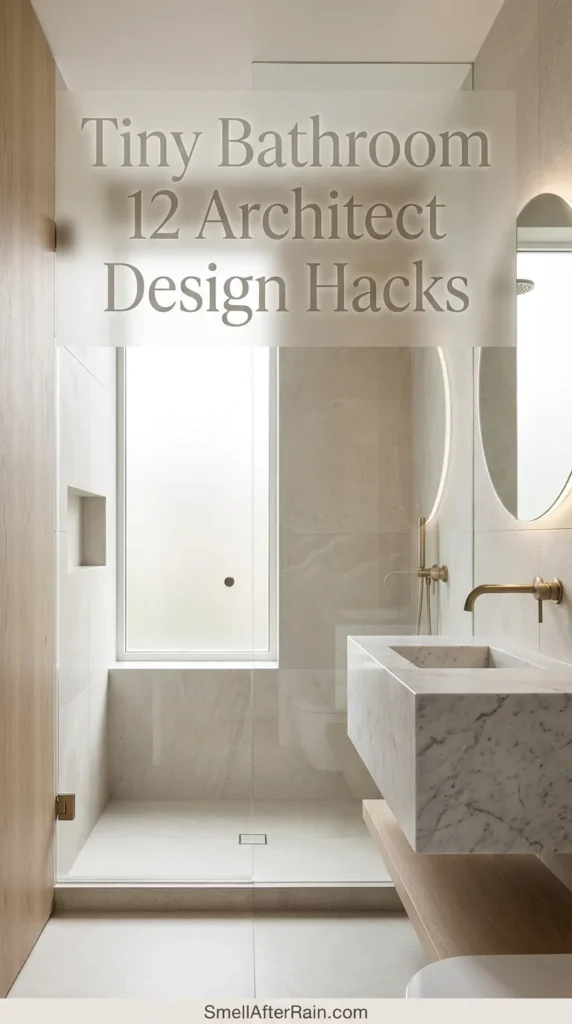
Shower curtains create a solid wall that visually cuts off a third of the bathroom when closed. Even framed glass doors add heavy lines that define limits. The superior choice for a tiny bathroom design is heavy, frameless glass.
Light Transmission
Frameless glass allows light to pass through unhindered, ensuring that the eye registers the full volume of the room, including the shower area. If privacy is a concern, smart glass (which turns opaque when engaged) or a frosted band at torso height offers seclusion without sacrificing the open feel. This transparency is crucial for maintaining the “airiness” required in minimalist small bathrooms.
6. Wall-Mounted Cabinetry and Fixtures: Reduced Visual Weight
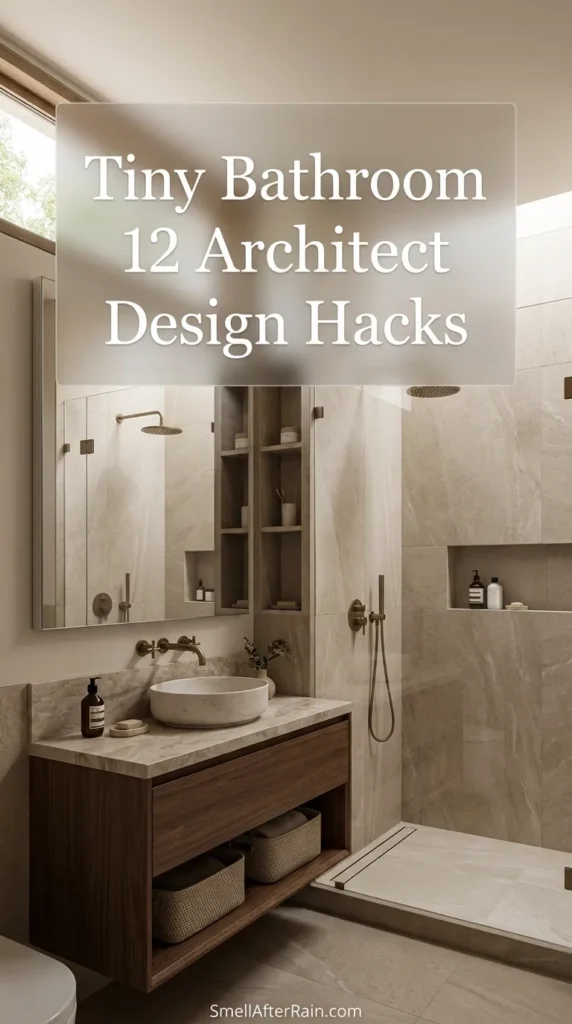
Just as the vanity should float, so should the toilet and faucets. Wall-hung toilets hide the tank inside the wall cavity, saving roughly 6 to 10 inches of depth. In a room where the distance between the toilet and the vanity might be tight, those inches are gold.
Technical Considerations
Wall-mounted faucets free up counter space, allowing for a narrower vanity sink without losing utility. This is a subtle but powerful luxury design secret. It also makes cleaning easier, as there are no faucet bases to gather grime. The aesthetic is sleek, modern, and intentionally architectural.
7. Strategic Mirror Placement: Doubling Depth
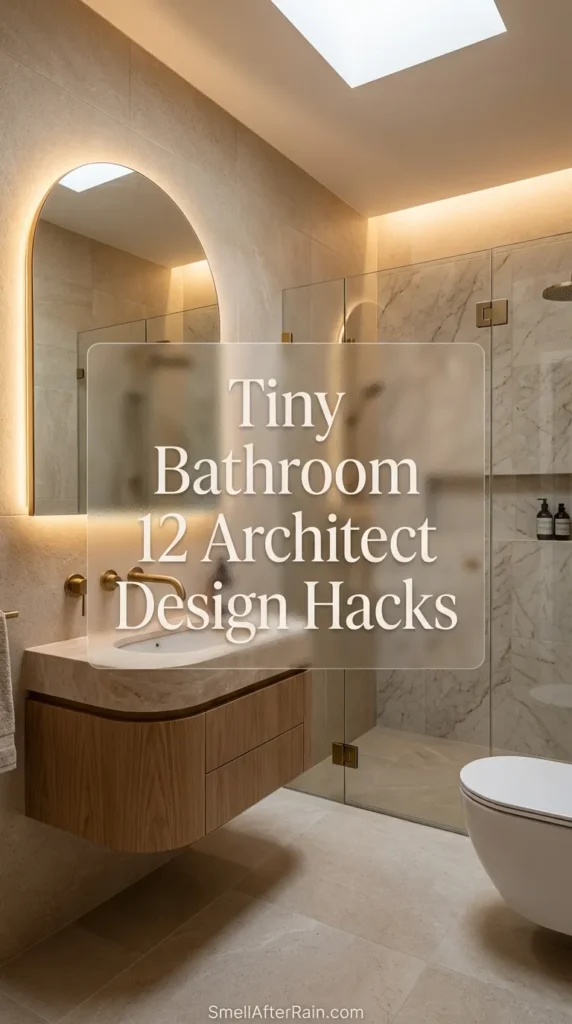
Mirrors are the oldest trick in the book, but their placement is often amateur. A small mirror above the sink does the job, but a floor-to-ceiling mirror or a wall-to-wall mirror can double the perceived space.
Optical Expansion
Positioning a large mirror opposite a window reflects natural light and “punches a hole” in the wall visually, suggesting space that doesn’t exist. In windowless bathrooms, placing a mirror behind a light source can amplify the illumination, banishing the shadows that make a room feel small and cave-like. For aesthetic bathroom vibes, consider a frameless, backlit mirror that adds a soft glow without visual bulk.
8. Recessed Niche Engineering: Flush Storage Solutions
Protruding shelves are enemies of the tiny bathroom. They impinge on shoulder width and movement zones. The architectural solution is the recessed niche—carving out space between the wall studs.
Structural Efficiency
A niche in the shower for shampoos, or above the vanity for daily essentials, keeps the walls flush. To elevate the design, line the niche with a contrasting material or light it with waterproof LED strips. This turns a utilitarian storage spot into a design feature, often seen in quiet luxury interiors. It signifies that the space was customized, not just decorated.
9. The Monochromatic Palette: Reducing Visual Noise
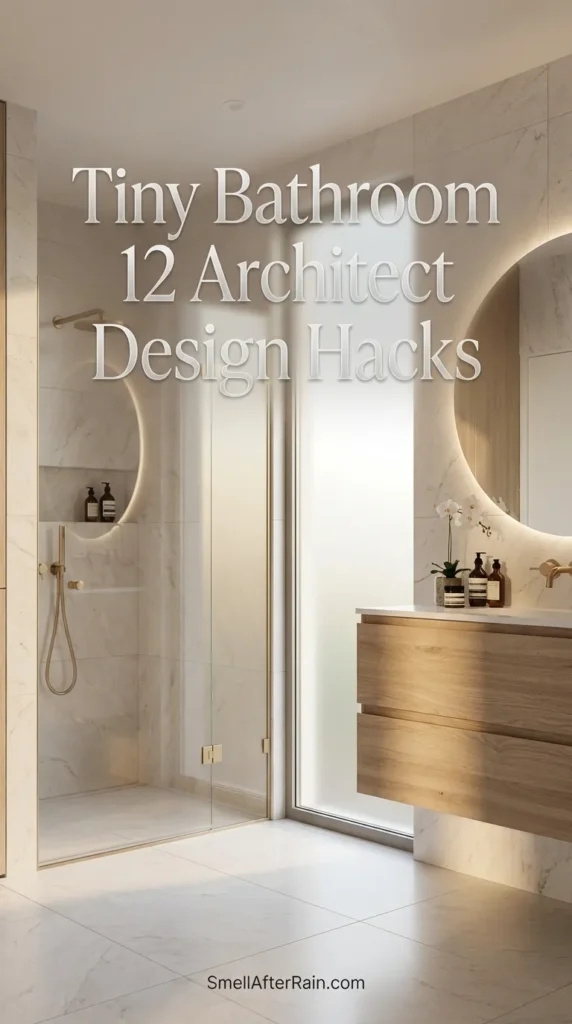
High contrast shrinks space. A black-and-white checkerboard floor, while classic, creates a busy grid that the eye must process. In a mini bathroom, a monochromatic or tone-on-tone palette allows the boundaries of the room to blur.
Color Theory
Soft whites, creams, warm greys, or muted earth tones reflect light and create a serene atmosphere. If you love color, apply it to the ceiling or via accessories. However, keeping the major surfaces (walls, floor, vanity) in the same color family reduces visual fragmentation, making the room feel like one cohesive, expansive unit. This aligns perfectly with modern bathroom design rules for calm.
10. Lighting Layering: Expanding Corners
A single overhead flush mount creates harsh shadows in the corners, effectively shrinking the room to the size of the light cone. A master bath approach to lighting is needed even in tiny spaces.
The Three Layers
1. Ambient: Recessed cans or a central fixture for general light.
2. Task: Sconces at face level to eliminate vanity shadows.
3. Accent: Toe-kick lighting under the floating vanity or LED strips in niches.
Bright corners recede, making the room feel wider. Using 3000K to 4000K bulbs mimics natural daylight, which is essential for opening up confined spaces.

11. Pocket Door Installation: Reclaiming Swing Arcs
A standard swing door requires roughly 9 square feet of clear floor space to operate. In a tiny bathroom, this is valuable real estate that could be used for a towel warmer, a plant, or simply breathing room. Replacing a swing door with a pocket door (which slides into the wall) recovers this space instantly.
Installation Notes
While this requires opening the wall, the payoff in usability is massive. If a pocket door isn’t structurally feasible (due to plumbing or electrical in the wall), a barn door on an external track is a viable alternative, though it does consume wall space. This simple switch can often be the difference between fitting a full vanity or settling for a pedestal sink.
12. Curated Corner Fixtures: Utilizing Dead Zones
Corners are often dead zones in rectangular rooms. However, in a super small bathroom, they are opportunities. Corner sinks, corner toilets, and corner showers are designed specifically to free up the central circulation area.
Geometric Optimization
A rounded corner shower enclosure softens the room’s geometry and prevents hip-bumping in tight spaces. While corner fixtures used to be considered dated, modern manufacturers now produce sleek, cozy bathroom appropriate versions that fit minimalist aesthetics. By rotating the functional elements 45 degrees, you often gain enough central floor space to make the room feel comfortable rather than claustrophobic.
Frequently Asked Questions
How do you arrange a tiny bathroom?
Arranging a tiny bathroom requires prioritizing flow. Place the largest fixtures (shower/tub) against the back wall to draw the eye through the room. Ensure the vanity and toilet are positioned to allow maximum clearance for movement. Use rounded edges on vanities to prevent injury in tight spaces and consider moving the door if it swings into a critical zone.
What colors make a small bathroom look bigger?
Light, cool colors generally make walls recede. Whites, off-whites, pale grays, and soft blues are standard for expansion. However, a dark, moody color (like charcoal or navy) can also work if used on all walls and the ceiling (color drenching) to blur the corners, creating an infinite, cozy depth.
Can you put a bath in a tiny bathroom?
Yes, but you may need a compact or Japanese soaking tub. These tubs are deeper but shorter than standard tubs, allowing for a full soak without the 60-inch length requirement. Alternatively, a wet room setup allows for a tub within the shower area if the waterproofing is comprehensive.
What is the best flooring for a small bathroom?
Large-format porcelain tiles or continuous stone slabs are best. Avoid small, busy patterns like penny tiles unless used sparingly, as the high volume of grout lines can make the floor look cluttered. Matching the floor color to the wall color also helps expand the space.
How much does it cost to remodel a tiny bathroom?
While material costs are lower due to less square footage, labor costs remain high because tradespeople (plumbers, tilers) are working in a confined space, often one at a time. A cosmetic refresh might cost $3,000-$5,000, while a full architectural renovation with plumbing relocation and high-end finishes can range from $15,000 to $25,000+.
How do I add storage to a bathroom with no cabinets?
Look to the walls and vertical space. Install a shelf above the door for rarely used items. Use a mirrored medicine cabinet recessed into the wall. utilize the space over the toilet with a hotel-style towel rack. Basket systems under a floating vanity also work well to contain clutter.
Conclusion
Transforming a tiny bathroom design from a cramped necessity into a spacious retreat is entirely possible with the right architectural approach. By focusing on recovering floor space with floating fixtures, utilizing vertical storage, and employing visual tricks like continuous tiling and strategic lighting, you can create a room that defies its square footage. Remember, the most successful small spaces are those that embrace their constraints and solve them with intentionality. For more inspiration on creating a serene home, explore our guide on cozy bathroom ideas for serenity.